
Reflections on 2025: Looking Back to Look Forward

By Kathy Booth and Randy Tillery
In this blog, the Center for Economic Mobility shares practical strategies for addressing current educational priorities including employer engagement, understanding the job market, and bridging noncredit and credit programs.
Reflections on 2025
This past year was unprecedented in many ways. In a manner similar to the pandemic, we found ourselves facing opportunities and losses that compelled us to find new ways to address long-standing challenges. But rather than receiving additional resources to support transformation, educators had to make hard choices as funding was delayed or eliminated.
Innovating with less gives us a chance to examine what is truly important. That’s why the Center for Economic Mobility expanded our work to build partnerships between employers, colleges, workforce development entities, and adult education providers to address barriers to economic mobility. Here are some of the ways we are helping more people and communities thrive.
Working with Employers to Tailor Solutions to Specific Populations
Two-dimensional supply-and-demand analyses provide a helpful starting place for aligning programs with job opportunities. However, strong academic programs do not always ensure that learners secure better employment. Partnerships between employers, educators, workforce programs, and social service providers help ensure that learners gain conceptual and applied knowledge, receive the wraparound supports necessary to participate in training, and build relationships that improve their chances of being hired. Furthermore, we need to clearly understand the skills that learners already possess to focus our efforts on the new competencies they need to achieve their goals.
For example, we are working with the California Community Colleges Chancellor’s Office and the United Healthcare Workers Joint Employer Education Fund to help healthcare workers prepare for higher level jobs by
- offering academic credit for prior learning, pairing social–emotional and work-readiness skills, and providing flexible schedules and hybrid formats;
- creating employer-sponsored clinical placements and providing clear information about next-level job requirements; and
- covering program costs and providing childcare, transportation, and wage replacement support.
These programs will not only boost workers’ earnings by 40 percent but will also reduce staff turnover and vacancy rates and strengthen connections between colleges and employers.

Making Sense of Labor Market Information
Starting in the 2010s, postsecondary institutions have focused on supporting more students in completing a certificate or degree. Now many are questioning the value of college and are pushing for transparency about economic outcomes for graduates—particularly in the context of paying back their debt. This shift can be challenging for institutions that do not have ready access to employment information. When practitioners see their students’ earnings numbers for the first time, they may find the results confusing because they assumed that graduates would earn higher salaries. If we expect students to secure stronger economic outcomes, educators will need additional information to clarify what actions they can take.
The Center is partnering with the National Association of State Systems to help colleges understand how the programs they offer relate to regional labor markets.
- Participants learn the basic principles of labor market analysis, practice applying this information in the context of such activities as outreach and student advising, and develop communications materials to engage colleagues about economic data.
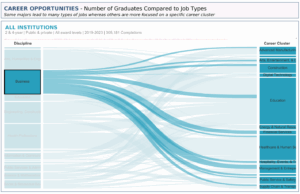
- We provide dashboards that show how majors relate to jobs, share tips on how to map academic outcomes to job skills, and offer strategies to support scaled interventions.
- Sessions support educators in building partnerships with employers and reducing the cost of attendance to maximize students’ return on investment.
By convening teams from multiple colleges within a state system, we are helping build communities of practice so educators can work together to adjust policies and pool resources to help link students with employers.
Building Pathways From Adult Education to College
Adult learners benefit from the flexible structures, built-in support, and practical focus of programs offered through noncredit and adult education. These programs help people build the foundational skills necessary to secure employment and improve their living conditions but often lead to entry-level jobs that do not pay living wages. Learners must return to school to build the additional skills needed for advancement. However, when the Center examined the rate of transition between noncredit and credit programs in California over the past decade, we found that only one in seven students took that next step. We also found that some programs had stronger outcomes, particularly when they assigned navigators to help learners with the required steps to reenroll and select the right courses.
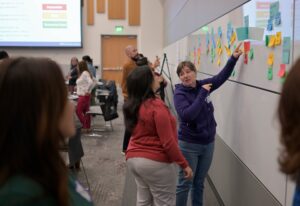
The Center is helping highlight the role of navigators and other effective practices so that more adults can advance in their careers. For example, at a Noncredit Summit for California community colleges, we shared the following tips:
- Institutionalize collaboration by scheduling frequent meetings among those who support adult learners, pooling resources across campuses to hire transition coordinators, and creating referral systems.
- Make structural shifts, including modifying the enrollment process, providing wraparound supports, and creating low-risk opportunities for adults to explore learning opportunities.
- Offer programs that provide realistic job opportunities and address students’ social–emotional and life needs.
You can learn more about our projects on the Center for Economic Mobility website. Each project page includes key lessons from our work and links to practical tools. Visit economic-mobility.wested.org, sign up for our newsletter for quarterly updates, and follow us on LinkedIn for weekly insights.