
Real Jobs, Real Skills, Real Lives: Redesigning Postsecondary Pathways for Working Adults

What does it really take for postsecondary education to pay off for working adults today?
In this blog post, you’ll learn how colleges can redesign worker-centered career pathways—grounded in labor market needs, in-demand skills, and learners’ real lives—so students aren’t left to navigate education and employment on their own.
While more and more people question the value of postsecondary education, the data are clear: College degrees open up opportunities for higher paying, stabler jobs. But a credential on its own doesn’t guarantee a good job. This uncertainty, paired with the rising cost of college, leads to valid questions about whether college is worth the time and resources involved.
Students who are struggling to cover their basic needs may see skipping or postponing postsecondary education as a risk-averse, rational choice. Unfortunately, while there are plenty of entry-level jobs that require little formal education, they often provide meager pay, involve physically challenging work conditions, have unpredictable hours, and offer few opportunities for growth. For these reasons, many workers become trapped in low-paying jobs.
Rethinking How Colleges Serve Working Adults
While postsecondary education is positioned to offer pathways out of low-paying jobs, too often students are left to make their own way: fitting school around jobs and caregiving, figuring out which credentials connect to in-demand careers, and translating learning into skills employers recognize. And colleges are facing their own pressures that require them to address the mismatch between students’ lives and postsecondary education offerings, including rising living costs, artificial intelligence, and new federal rules that measure the earnings outcomes of individual programs.
The futures of both our nation’s workers and our postsecondary institutions depend on transforming college education to offer worker-centered career pathways that lead to well-paid, stable jobs. That transformation starts with a deep understanding of the labor market and a three-dimensional approach to building workers’ skills.
Understanding the Labor Market
WestEd’s Center for Economic Mobility partners with the National Center for Inquiry and Improvement (NCII) to examine labor market information and create actionable analyses for postsecondary institutions.
While every regional labor market has its eccentricities and unique elements, WestEd and NCII have found that labor markets across the country have many more similarities than differences. Data show that the same good jobs show up again and again, whether in Hawaiʻi, Texas, or Alabama: Educators, supervisors, and select healthcare positions are consistently in-demand, living-wage jobs. These roles represent an untapped opportunity to build pathways from low-wage jobs to family-sustaining, stable careers.
NCII offers valuable analyses that colleges and others can use to understand career pathways into these good jobs. As shown in the figure, their analyses organize occupations into four quadrants of jobs spanning low-wage. For example, an administrative assistant from a midsized region in Ohio could increase their income by becoming a supervisor or pursuing additional education to qualify for an operations manager position. By drawing connections between jobs across the spectrum, colleges can begin mapping realistic career pathways that build on the skills and experiences of workers.
Example of Top Five Jobs Across Four Salary Quadrants in Business
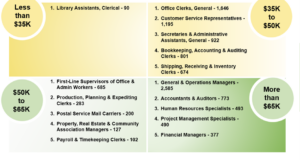
Credit: Rob Johnstone, National Center for Inquiry & Improvement, 2026.
The Real World Requires a Three-Dimensional Approach
Across all sectors, workers advance by acquiring skills that enable them to transition from low-wage jobs to better paying ones. Helping more workers make that transition requires colleges to think creatively about how to structure their programs and credentials in ways that fit working adults’ lives. WestEd’s Center for Economic Mobility has designed a three-dimensional approach to skills-development, organized around three key dimensions to which colleges tailor their educational offerings.
Existing Good Jobs
This dimension depends on understanding existing labor market opportunities. Critically, the road to better pay varies across career clusters. For child care workers, becoming a teacher requires a bachelor’s degree and a teaching certification. Meanwhile, a home health aide can complete a short-term program that enables them to work as a licensed vocational nurse and then return at a later point in their career to earn an associate degree in nursing. For those working in retail, warehouse, or administrative spaces, supervisory roles offer a pathway to a significant pay increase. Colleges offering a certificate that prepares frontline workers within a range of industries for supervisory roles will create opportunities for workers to increase their pay in a short amount of time.
Prospective Workers by Occupation and Industry
A home health aide, a retail worker, a daycare assistant, and a warehouse stocker all have different skills. Colleges can capitalize on workers’ existing skills and experience by creating clear pathways from current employment to related occupations. Being specific about which learners to recruit, enroll, and support also allows colleges to design programs that accommodate the realities of working in those specific fields. For instance, a first-line supervisory certificate program would benefit from asynchronous and online offerings, while a transfer pathway for child care workers would need to offer evening courses. It is equally important for colleges to consider the contexts of workers’ lives and common barriers that prevent them from persisting. Holistic supports ranging from emergency funds to public benefits to child care are critical for enabling more students to complete their credentials.
Employer Needs
Employers are invaluable partners in helping colleges create career pathways for working adults. Building formal, systematized partnerships enables colleges to better serve their students. Employers offer critical information about in-demand skills that colleges can use to shape educational program learning outcomes and curricula. A close partnership between education and industry enables the translation of skills and experiences between the contexts. The partnership acts as a translator, enabling a college to prepare its students to communicate their skills and qualifications to prospective employers. Employers also provide pathway-specific employment opportunities both while students are enrolled and after they complete their programs.
The Three-Dimensional Approach in Action: Back on Track
To put the three-dimensional approach to skills development into action, WestEd’s Center for Economic Mobility and NCII are implementing Back on Track, a multiyear demonstration project in partnership with eight community colleges from across the country. WestEd and NCII are providing labor market research, technical assistance, and peer-to-peer learning to support participating institutions as they strengthen career pathways into high-demand fields of education, healthcare, and supervisory roles.
To learn more about WestEd’s and NCII’s work transforming how community colleges design career pathways in high-demand fields, visit these webpages:
- Technical Assistance that Empowers Community Colleges to Redesign Career Pathways for Young Adult Workers
- Career Connections
Back on Track is one effort to test what it looks like to build worker-centered pathways at scale—so that learners don’t have to shoulder the burden of navigating education, employment, and skill translation alone. For more adults to enroll, persist, and move into stable, family-sustaining careers, it is critical that colleges design pathways around real jobs, real skills, and real lives.
Alex Lozanoff is a senior project manager in WestEd’s Center for Economic Mobility. Alex leverages training in policy analysis and human-centered design with experience leading student success initiatives at public universities to deliver action-oriented professional development. The focus of her work is on empowering postsecondary clients to transform data into action that equitably improves outcomes for students with marginalized identities. Alex earned a bachelor of arts in history from the University of Pennsylvania and a master of public policy from UC Berkeley’s Goldman School of Public Policy.